
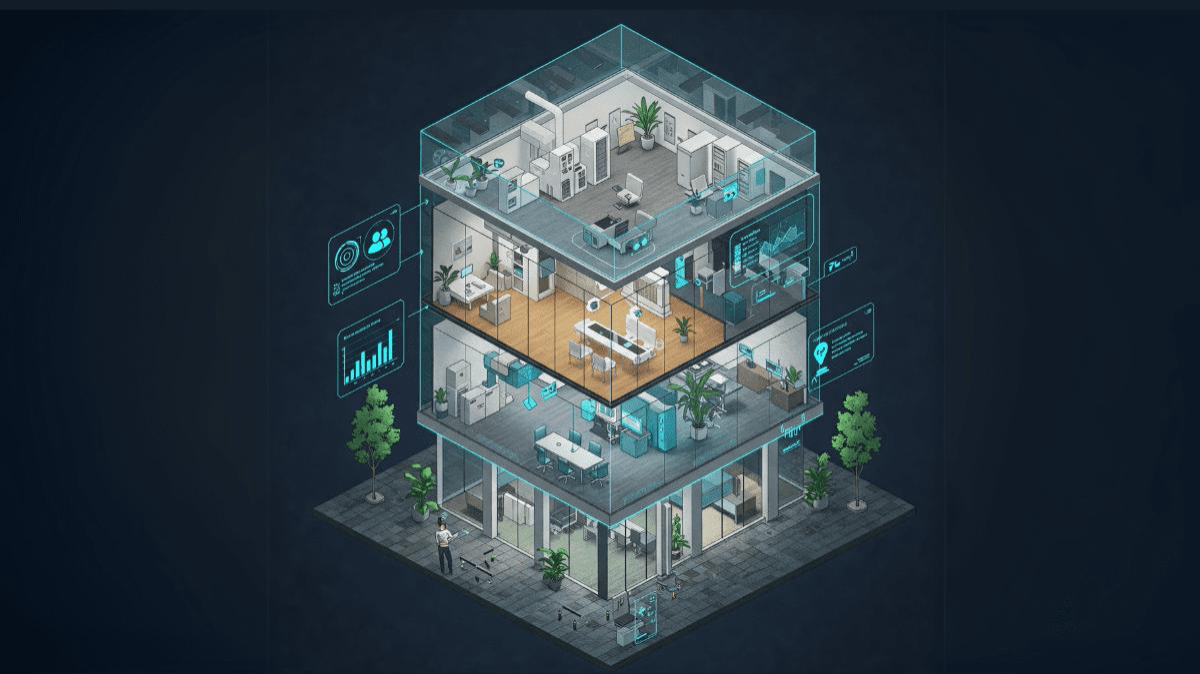
Beyond Desk Booking: Why the Future of Workplace Management Is Spatial
Desk booking software manages reservations. Zynq manages the space itself — a digital twin for smarter, spatial workplace management.
For years, workplace technology has been built as a patchwork of disconnected systems. One tool manages desks. Another manages meeting rooms. A third tracks occupancy. A fourth handles access control. A fifth bolts on analytics after the fact. Each piece solves its own problem — and none of them answer the question that actually matters: how do people experience and move through a workplace?
At Zynq, we think workplace management should work the way people actually think about their office: through space, not spreadsheets.
What Is Spatial Workplace Management?
Spatial workplace management is an approach to running an office where every desk, room, and resource exists as a digital object placed inside an interactive floorplan — not as a row in a booking table. Instead of scanning a list to find an available desk or room, employees see and interact with the workplace itself, the same way they would walk through it in person.
That distinction — treating physical space as the interface, not just the output — is what separates a true digital twin of the workplace from a traditional reservation system.
The Problem With Traditional Workplace Software
Most workplace platforms are organized around records, not space:
- One tool manages desks.
- Another manages meeting rooms.
- A third tracks occupancy.
- A fourth integrates with access control.
- A fifth attempts analytics and reporting, stitched on after the fact.
Each piece works in isolation. None of them show you the workplace as a whole, or make it easy for employees to simply see where to go.
The Evolution of Workplace Management Software
The category has matured fast over the last decade. Platforms like Condeco, Robin, Envoy, OfficeSpace, Skedda, and YArooms helped modernize room reservations, desk booking, visitor management, and hybrid workplace operations — and pushed the entire market forward.
But most of these systems still treat physical space as a list: rows of desks, calendars of rooms, logs of visitors. Zynq starts from a different premise.
The Floorplan Isn't a Picture — It's the System of Engagement
In most workplace software, a floorplan is decoration: a visual layer sitting on top of the real booking data.
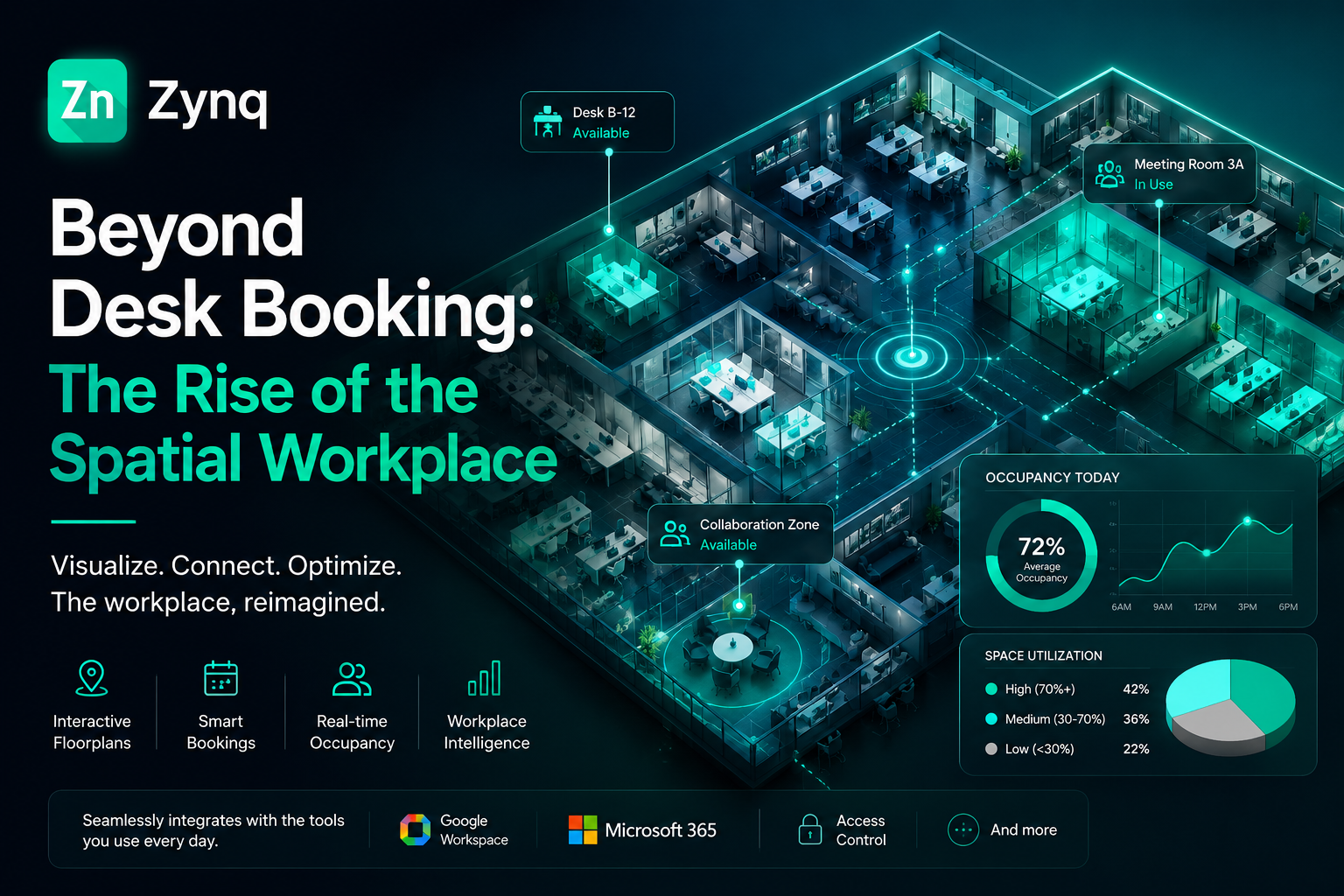
In Zynq's Live Floorplans, the floorplan is the product. Every desk, meeting room, parking spot, and resource is a digital object with location intelligence built directly into the map. Employees don't search a list — they navigate the office visually and interact with the space itself, the same way they would in person.
Zynq's Digital Twin of the Workplace
What makes Zynq different isn't just booking desks or reserving rooms — plenty of tools do that. It's that the platform builds a live digital twin of the physical office, where:
- Desks become bookable, spatially aware resources.
- Meeting rooms show real-time availability, synced to Google Workspace or Microsoft 365.
- Occupancy is visible as it happens, not in yesterday's report.
- Visitors check in and get routed through the same spatial layer as employees.
- Workplace policies — neighborhoods, team zones, capacity limits — are built into the booking experience itself, not bolted on.
The floorplan becomes the operating system for the workplace — a fundamentally different experience than a list of reservations will ever be.
How Zynq's Spatial Intelligence Works
Under the hood, a few core capabilities make this possible:
Spatial Resource Modeling
Every desk and room is placed at precise coordinates within the floorplan, so employees interact with real physical space instead of an abstract row in a database.
Intelligent Seat Selection
When someone doesn't care exactly which desk they use, Zynq can automatically assign the best available option based on:
- Availability
- Permissions
- Team assignments
- Existing reservations
- Historical usage patterns
Real-Time Room & Desk Awareness
Status updates dynamically across the platform. A change made in a connected calendar shows up instantly in the floorplan — no stale data, no double-booked rooms.
Enterprise Integrations
Workplace management doesn't run in isolation. Zynq connects with the systems already running the business:
- Google Workspace
- Microsoft 365
- Access control systems
- HR platforms
- Collaboration tools
- Workplace displays and kiosks
The value isn't the integration list itself — it's that workplace operations become one connected experience instead of five disconnected tools.
Why Spatial Workplace Management Matters Now
Hybrid work changed what organizations need to know about their own real estate. Questions that didn't used to matter now sit on every facilities leader's desk:
- How much office space is actually being used?
- Which floors or neighborhoods are sitting empty?
- How should teams and neighborhoods be organized as headcount shifts?
- Are employees finding the resources they need when they come in?
- How do you improve the in-office experience while cutting real estate costs, not raising them?
None of those questions can be answered by a booking log. They require understanding how people actually move through and use physical space — which is exactly what spatial workplace management is built to show.
Beyond Desks and Rooms: One Platform for Any Physical Space
The most interesting part of Zynq's architecture is that the underlying model isn't limited to desks and meeting rooms. Anything that exists in physical space can be represented, visualized, and managed the same way, including:
- Parking spaces
- Collaboration zones
- Equipment and devices
- Manufacturing workstations
- Lab environments
- Healthcare facilities
- Warehousing operations
- Campus environments
If it exists in physical space, it can be represented, visualized, and optimized through the same spatial layer.
The Next Generation of Workplace Platforms
Workplace software is moving past reservations and calendars. The next generation of platforms will blend digital twins, spatial computing, real-time workplace intelligence, resource optimization, and AI-driven recommendations.
Organizations won't just ask whether a desk is free. They'll ask:
- "Where should my team sit today?"
- "Which neighborhood best supports collaboration this week?"
- "How should we reconfigure this floor as our workforce changes?"
Answering those questions starts with understanding space itself — and that's where we believe workplace management is headed.
Frequently Asked Questions
What is spatial workplace management?
Spatial workplace management runs desk booking, meeting rooms, visitor management, and workplace analytics through an interactive floorplan — a digital twin of the office — instead of separate lists and calendars. Employees interact with the space itself rather than searching records.
What is a digital twin for the workplace?
A digital twin of the workplace is a live digital replica of an office where every desk, room, and resource exists as a spatially aware object. It updates in real time as bookings, occupancy, and calendar changes happen, so the floorplan always reflects what's actually going on in the building.
How is Zynq different from Envoy, Robin, or OfficeSpace?
Tools like Envoy, Robin, and OfficeSpace are built around booking records — lists of desks, rooms, and visitors. Zynq is built around the floorplan itself: every resource is a spatial object, so the interactive map is the primary way employees book, navigate, and understand the workplace, not a secondary view on top of a database.
Does spatial workplace management work for spaces beyond desks and meeting rooms?
Yes. Because Zynq's underlying model represents any resource spatially, the same platform can manage parking, collaboration zones, equipment, manufacturing workstations, lab space, healthcare facilities, and campus environments — not just office desks.
How do I get started with Zynq?
You can book a live demo to see Zynq's floorplans, desk booking, meeting rooms, and workplace analytics in action, or explore the full feature set first.
The workplace of the future isn't a list. It's a place. See it for yourself.
