
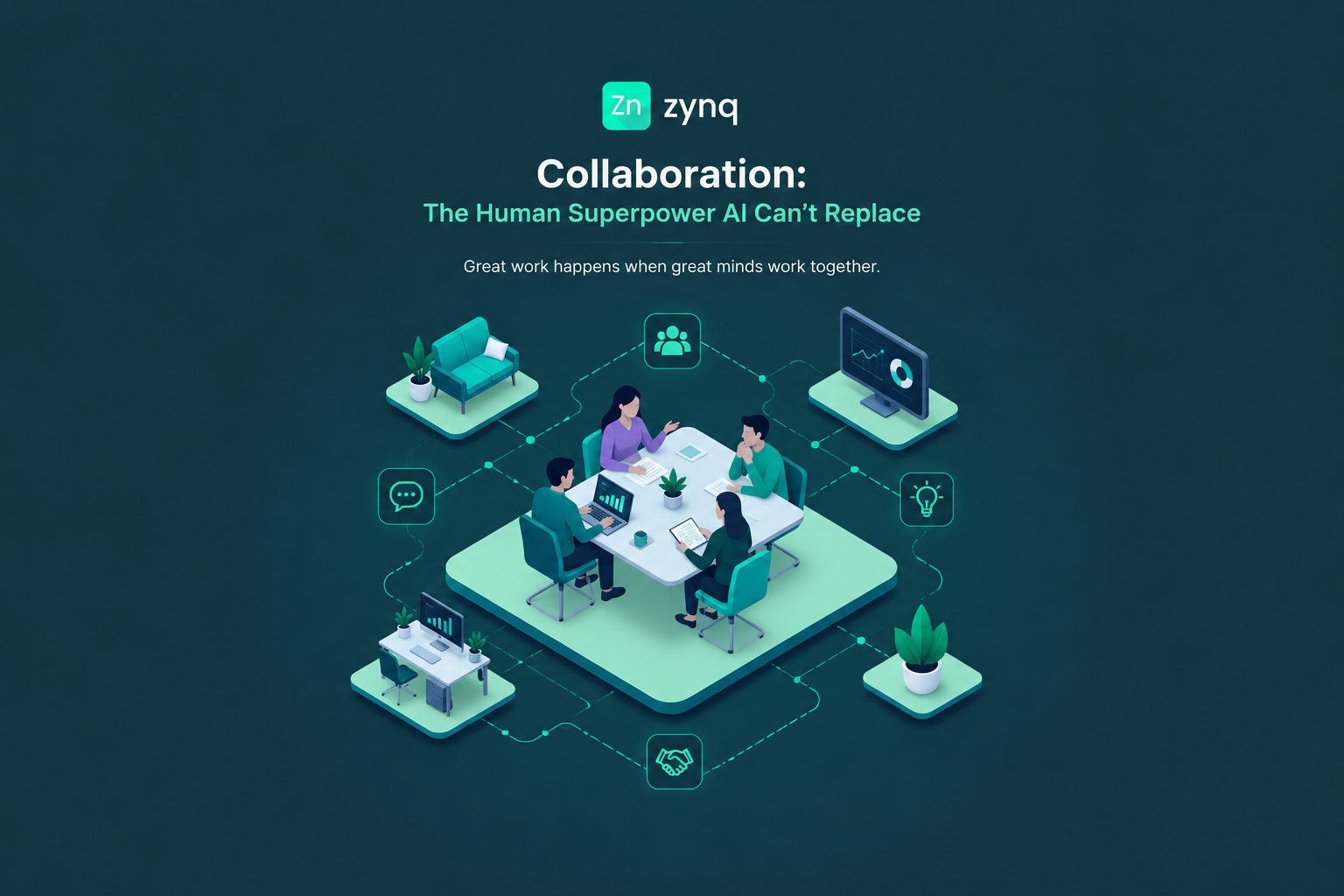
Collaboration: The Human Superpower AI Can’t Replace
AI is accelerating individual productivity, but real innovation still depends on human collaboration. As hybrid work evolves, organizations must rethink how they coordinate people, spaces & teamwork in the age of AI.
As artificial intelligence and automation continue transforming every corner of the workplace, one question rises above almost everything else: What uniquely human qualities will matter most in a world increasingly powered by machines?
AI can process enormous amounts of information, generate content in seconds, automate workflows, and even simulate conversation remarkably well. But there are still deeply human capabilities that technology struggles to replicate.
One of the most important among them is collaboration. Not just communication. Not just meetings. Real collaboration.
The kind that happens when people challenge each other’s thinking, build trust, exchange ideas, navigate ambiguity together, and collectively create something bigger than what any individual could accomplish alone.
In many ways, collaboration may become even more valuable because of AI.
AI Is Increasing Individual Productivity — But That Alone Isn’t Enough
We are entering a world where individual employees can move incredibly fast.
- A marketer can create campaigns in minutes.
- An engineer can generate code with AI assistance.
- A product manager can summarize research instantly.
- An analyst can process massive amounts of data without spending days in spreadsheets.
AI is dramatically amplifying individual execution.But organizations do not succeed because individuals work faster in isolation. They succeed when teams align.
Because the hardest problems inside companies are rarely isolated technical tasks. They are coordination problems: aligning teams, sharing context, making decisions, resolving tradeoffs, balancing priorities and turning many moving pieces into coherent execution.
That is where collaboration becomes critical.
Innovation Has Always Been a Team Sport
Think about the most impactful moments inside organizations. They usually don’t happen because one person quietly completed a task alone.
They happen in:
- whiteboard sessions,
- strategy discussions,
- hallway conversations,
- brainstorming meetings,
- mentoring moments,
- customer workshops,
- and spontaneous interactions between people with different perspectives.
The magic often comes from the collision of ideas. AI can assist those interactions. But it cannot truly recreate the human dynamics behind them: empathy, trust, emotional intelligence, persuasion, creative tension and shared purpose.
That remains uniquely human.
Hybrid Work Made Collaboration More Intentional
One of the interesting side effects of hybrid work is that companies can no longer assume collaboration happens automatically.
In the past, people often collaborated simply because they sat near each other.
Today, teams are distributed. Schedules vary. Offices are more fluid. Employees balance focus work at home with collaboration time in-office.
As a result, organizations are having to think much more intentionally about:
- when teams come together,
- where collaboration happens,
- how shared spaces are used,
- and how to create environments that foster meaningful interaction rather than just occupancy.
This is where workplace coordination starts becoming strategically important. Because collaboration does not happen simply because an office exists.
It happens when people, spaces, timing, and intent align effectively.
The Workplace Is Becoming a Coordination Layer
One of the biggest shifts happening right now is that offices are evolving from static physical locations into dynamic collaboration hubs. The purpose of the workplace is no longer just providing desks.
Increasingly, it is about helping people:
- connect,
- collaborate,
- innovate,
- and coordinate more effectively.
That requires much more than traditional scheduling systems. Organizations are beginning to think more deeply about:
- team coordination,
- shared resources,
- collaboration spaces,
- workplace utilization,
- employee experience,
- and operational flexibility.
At Zynq, this is something we think about constantly.
What started as workplace and desk management increasingly feels like a broader challenge around orchestrating people, spaces, and shared resources intelligently in hybrid environments. Not because booking a desk is inherently valuable — but because enabling better human collaboration is.
Collaboration Will Become a Competitive Advantage
As AI continues automating more execution-oriented tasks, collaboration may become one of the defining differentiators between average organizations and exceptional ones.
The companies that thrive will not simply be the ones with the best AI tools.
They will be the ones that:
- create alignment faster,
- bring people together more effectively,
- foster stronger human connection,
- and enable coordinated execution across teams.
Because in the end, AI may accelerate productivity. But collaboration is what turns productivity into innovation.
Final Thought
AI is not replacing the importance of human collaboration.
If anything, it is amplifying it. The faster individuals can move, the more important it becomes for organizations to ensure people are moving together in the same direction.
Curiosity, critical thinking, confidence, commitment, and collaboration are not “soft skills” in the age of AI. They are the very capabilities that will define the next generation of leaders, teams, and organizations.
And among them, collaboration may ultimately prove to be the most human superpower of all.
